Bridget Darcy’s grief over Mark
Bridget Jones: Mad About the BoyBridget Darcy’s grief over Mark is a continuing presence in her life as a widow and mother: it returns in memories, gathers around the children’s milestones, and surfaces in moments that might otherwise belong wholly to the present. The moon that Mabel says follows her, the photographs brought out for Father’s Day, and Bridget’s remembered scenes of family life make grief both an ache of absence and a way the family continues to address Mark.
The death and its aftermath
Bridget’s account looks back five years to the news of Mark Darcy’s death in 2008. The first shock remains in fragments: Billy running through the house saying he had lost his father; Jeremy and Magda arriving with a policeman; Bridget rushing to hold the children as they asked what was wrong; government visitors in the living room; and the news showing Mark’s face beneath the dates of his life. The disjointed recollection conveys how the event persists less as a neatly ordered story than as a collection of images that can still bring the past abruptly into the present.
The newspaper cutting Bridget reads later supplies the public record behind that intimate memory. Mark, a British human rights lawyer, was killed in Darfur, Sudan, when the armoured vehicle carrying him struck a landmine. Anton Daviniere, a Swiss representative of the UN Human Rights Council, died in the same incident. The report describes Mark’s work in cross-border litigation, conflict resolution, victim representation, and transitional justice, and records his support for Amnesty International. It also recalls that his intervention helped secure the release of British aid workers Ian Thompson and Steven Young after seven months as hostages. Alongside tributes from heads of state, aid agencies, and individuals, the report identifies the family left behind: Bridget, Billy, then two, and Mabel, then three months old. The account makes clear that the man whose absence shapes the children’s home was also a consequential figure in public life.
Grief inside the work of mothering
In the early aftermath, Bridget remembers waking at five in the morning and, for a brief instant, believing life had not changed. Recognition then struck with physical force. She had to get up for nappies and bottles, hold things together until help arrived, and find somewhere private to cry before returning to the children. The practical sequence did not resolve the grief; it dictated how she had to live beside it. Her governing imperative was Keep Buggering On (KBO), because caring for Billy and Mabel left no choice but to continue through each day.
Bereavement counsellors and therapists helped the children with honesty, conversation, and manageable versions of the truth. Bridget, however, found that advice about grieving offered less immediate help than working out how to change a nappy while microwaving a fish finger. She describes keeping the family afloat as most of the battle. Mark had arranged the financial details and insurance policies, and the family moved from the memory-filled house in Holland Park to a smaller house in Chalk Farm. School fees, bills, and income had been provided for; what remained to Bridget was the work of raising the children and the private feeling that, despite functioning as their mother, she had become an empty shell.
Years later, memory still arrives through intimate particulars rather than a single, settled recollection. Bridget remembers Mark sleeping with an arm across her shoulder, the feel of his suit against her skin, his brown eyes when he spoke about work, and his hours spent doing difficult puzzles with Billy. These recollections make the loss especially sharp when a child reaches a new stage or does something that might once have been shared with Mark. Bridget resists the idea that every sweet moment with the children must be tinted by sadness, yet the remembered father remains part of how she experiences their lives.
The moon and the family’s continuing bond
During a night of intense grief, Bridget sits among photographs and cuttings and writes Mark a letter. She tells him she is lonely, misses his comfort and counsel, and cannot bear that he will not see the children grow up. She also recalls the work he undertook to free the hostages and recognizes that he had tried to ensure it was safe. Her thoughts turn toward the children’s future without him, then toward the counterfactuals she is trying to resist. The letter holds love, anger at the life they have lost, guilt, and an effort to keep living in the same breath.
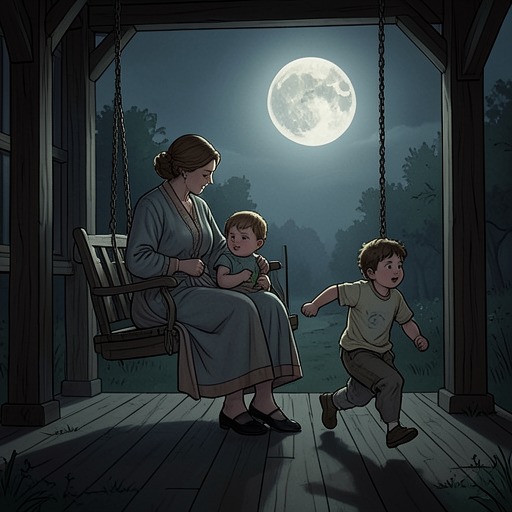
At midnight, Mabel gets down from the bunk bed and tells Bridget that the moon follows her; she also points out an owl. The full moon above the small garden gives Bridget a moment in which her daughter’s observation is at once a child’s discovery and a comfort she cannot explain away. Later, during a country weekend with Roxster, another full moon recalls Mabel’s words and the many times Bridget thought the moon had followed her and Mark. The memory rises even amid a happy escape, showing that renewed intimacy and pleasure do not cancel the past. The moon works as a recurring link between a shared family memory and Bridget’s present life.
Rituals, anniversaries, and recurrence
Father’s Day makes the children’s continuing relationship with Mark visible in the simplest of objects. When Billy tells Bridget that he and Mabel have made cards, she pulls over the car and looks at their drawings: one depicts a family with a father, mother, girl, and boy; the other shows a boy playing with his father and carries the word Daddy. Mabel asks whether they can post the cards to him. At home, Bridget brings out photographs of Mark with the children, including Billy standing beside his father in a matching suit and pose, and Mark holding newborn Mabel. They talk about Daddy and post the cards; Mabel addresses hers to Daddy in Heaven and Space. The act cannot restore Mark, but it gives the children a concrete way to speak to him and lets Bridget affirm that their love continues.
The memory of Mark also appears in Bridget’s anticipation of Billy’s summer concert. As she settles him to sleep beneath another full moon, she imagines how Mark would have handled the mass of picnic emails: deleting them and replying that he would bring hummus and black bin liners. The practical joke of this imagined efficiency makes the absence painfully specific. Bridget recognizes that the concert would have been an entirely lovely occasion if Mark were going with her, then urges herself to brace up and keep going.
At Christmas, the present folds together earlier seasons of Bridget’s life: childhood services in Grafton Underwood with her parents; teenage attempts not to laugh as her mother and Una sang; the lonely years when she feared she would never have a child; her father’s last Christmas after leaving hospital for Midnight Mass; and Christmases with Mark and the children. The first nativity play after Mark’s death remains especially difficult, because the holiday seemed cruel simply for continuing. When Bridget cries during the later service, Mabel grips her hand and asks her not to. Bridget wipes away her tears and joins the singing. The gesture does not signal that grief is over; it shows the children and their mother meeting the remembered loss together, within a ritual that returns each year.